

Sidharth Dhody represents the modern transactional lawyer who combines technical legal expertise with commercial understanding, problem-solving, and a strong focus on helping businesses achieve their objectives. As a Partner at IC RegFin Legal Partners LLP, his practice is rooted in corporate transactions, regulatory advisory, and financial legal frameworks. His approach reflects the evolving expectations of clients today—lawyers are no longer expected merely to identify risks; they are expected to understand the business objective, find practical alternatives, and help transactions move forward.
In this episode of The Koffee Conversation Show – The Emerging Lawyer Series, themed “A Conversation on Financial Legal Frameworks with Sidharth Dhody,” Sidharth shares valuable insights on corporate transactions, financial frameworks, regulatory challenges, client expectations, deal-making, relationship building, AI, LegalTech, leadership, commercial judgment, and the evolving role of transactional lawyers. His perspective highlights a critical truth—successful legal advice is not simply about identifying what can go wrong; it is about understanding the bigger picture and finding a pragmatic way forward.

Sidharth’s journey into corporate and transactional law evolved gradually. While pursuing his bachelor’s degree in commerce at Delhi University, he developed a strong interest in the intersection between law and business, particularly negotiations and problem-solving. Law school exposed him to different areas of practice, but transactional work stood out because it required lawyers to understand client objectives, anticipate risks, negotiate competing interests, and ultimately make a transaction work. His career since then has been defined by constant learning, adaptation, and increasing responsibility.
A defining aspect of Sidharth’s professional journey has been his evolution from individual contributor to leader. Becoming a partner, he explains, is not simply about a title—it means taking responsibility for clients, teams, relationships, and the future direction of a practice. His leadership philosophy centres on creating an environment where people can do their best work, giving them ownership, and helping them develop independent judgment. He also emphasizes that a legal career is a marathon, not a sprint, requiring patience, resilience, communication, commercial judgment, and attention to detail.
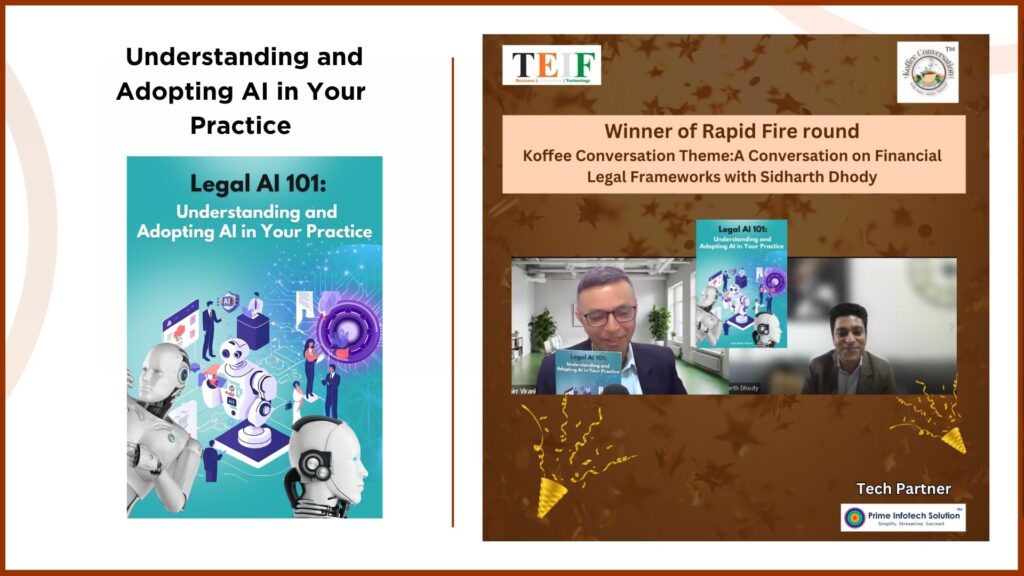
Key Highlights of the Koffee Conversation with Sidharth Dhody
- Modern lawyers are increasingly expected to become deal facilitators.
- Clients want practical solutions rather than only a list of legal risks.
- Identifying an alternative route can help a transaction move forward.
- Transaction timelines have become significantly faster.
- Complex transactions require lawyers to break problems into manageable parts.
- Understanding every stakeholder’s commercial objective is critical.
- Prioritization helps lawyers manage multiple moving parts without losing important details.
- Precision is non-negotiable in transaction work.
- Alignment between stakeholders is one of the biggest factors behind successful deals.
- Clear commercial objectives make legal and regulatory challenges easier to navigate.
- Relationships are built through trust, consistency, and reliability.
- Client relationships must go beyond simply providing legal advice.
- Professional relationships across bankers, lawyers, financial advisers, and counterparties can significantly influence deal execution.
- Relationships should never become purely transactional.
- The most valuable transactions are often the ones that do not go according to plan.
- Unexpected complexities develop pragmatic and commercial thinking.
- Becoming a partner means taking responsibility beyond the quality of one’s own work.
- Leadership is about creating an environment where people can perform at their best.
- Good leaders give people enough ownership to develop their own judgment.
- A legal career is a marathon rather than a sprint.
- Young lawyers should focus on sustainable long-term growth rather than trying to achieve everything immediately.
- AI and LegalTech can significantly improve efficiency in transactional practice.
- Lawyers can outsource tasks to AI, but they cannot outsource professional judgment.
- Human experience remains critical when deciding what solution best serves a client.
- Document comparison and proofreading tools can help lawyers identify small errors that may otherwise be missed.
- LegalTech can improve the efficiency and quality of document review.
- Communication is one of the most underestimated skills for transaction lawyers.
- Complex legal issues must be translated into language that business teams can understand and act upon.
- Commercial judgment helps lawyers distinguish genuinely critical issues from those that can be resolved pragmatically.
- Attention to detail must be balanced with an understanding of the bigger transaction.
- Technical legal knowledge alone is not enough to become an effective transactional lawyer.
- Lawyers need to understand business objectives, negotiations, stakeholders, and commercial realities.
- Reading and writing can strengthen communication and provide balance outside professional life.
- Fiction can also contribute to creativity and communication skills.
- Professional identity should not completely define personal identity.
- Young lawyers should build a life beyond being a lawyer.
- Consistency, curiosity, adaptability, and continuous learning are essential for long-term success.
▶️ Watch the full episode on YouTube on The Koffee Conversation Show – The Emerging Lawyer Series to explore how corporate transactions, financial legal frameworks, commercial judgment, AI, LegalTech, leadership, client relationships, and strategic problem-solving are shaping the future of transactional law.
🎧 Listen to the complete podcast on Spotify: The Koffee Conversation Show – The Emerging Lawyer Series to discover Sidharth Dhody’s insights on financial legal frameworks, corporate transactions, deal facilitation, AI, LegalTech, leadership, commercial judgment, and what it truly takes to become a trusted adviser in the world of transactional law.









0 Comments