

Gayatri Kulkarni brings together more than 17 years of experience across litigation, legal education, and corporate consulting, with a professional journey that has increasingly focused on creating safer, more inclusive, and accessible environments. As an Advocate, her work extends beyond traditional legal practice into POSH compliance, disability rights, workplace inclusion, and legal education. Her personal journey as a parent of a child with multiple physical disabilities has given her a deeply personal understanding of accessibility, dignity, and the everyday barriers faced by persons with disabilities.
In this episode of The Koffee Conversation Show – The Emerging Lawyer Series, themed “From Advocacy to Inclusion: Gayatri Kulkarni on Building Safer Workplaces and an Accessible Society,” Gayatri shares meaningful insights on POSH compliance, disability inclusion, accessible grievance mechanisms, workplace culture, technology, education, legal guardianship, social impact, and the responsibility of organizations to create environments where everyone can participate with dignity. Her message is particularly powerful: inclusion should never remain a policy document—it must become a lived reality.

Gayatri’s professional journey has been shaped by three interconnected worlds—the courtroom, classroom, and corporate environment. Her early litigation experience under senior advocate Arvi Mudgar taught her procedure, evidence gathering, cross-examination, drafting, professional ethics, and courtroom etiquette. Her subsequent experience as a lecturer helped her translate complicated laws into language students could understand, while her transition into the corporate world, under the guidance of senior corporate lawyer Purima Dave, gave her insight into business operations, leadership, and practical compliance.
Her experience as an educator continues to influence her consulting and training work. Teaching subjects such as contract law, women and law, sociology, criminology, and penology helped her understand how legal rules interact with social realities and workplace power dynamics. This perspective became especially important in her POSH work, where she emphasizes that compliance is only the minimum standard. A genuinely safe workplace is one where employees feel psychologically safe enough to speak up and where grievance mechanisms are accessible to everyone.
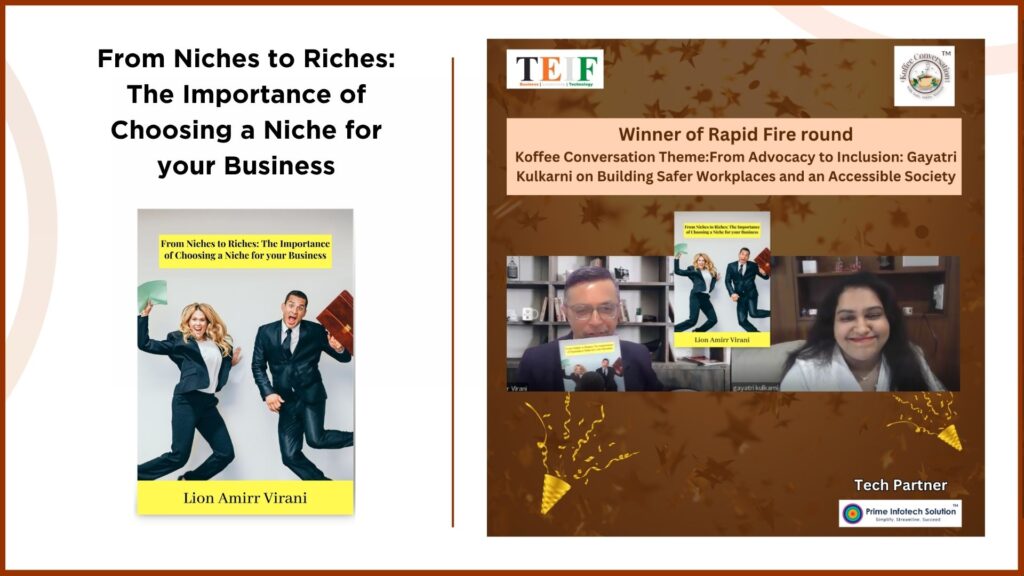
Key Highlights of the Koffee Conversation with Gayatri Kulkarni
- Gayatri’s professional journey spans litigation, legal education, and corporate consulting.
- Her career has been shaped by the courtroom, classroom, and corporate environment.
- Her early litigation experience taught her procedure, evidence gathering, cross-examination, drafting, ethics, and courtroom etiquette.
- Her experience as a lecturer helped her simplify complicated legal concepts.
- Legal educators can play an important role in making law understandable to non-lawyers.
- Corporate consulting gave her a deeper understanding of how businesses operate.
- Practical compliance requires understanding how organizations function at ground level.
- Teaching women and law helped develop her understanding of workplace power dynamics.
- Social subjects such as sociology and criminology strengthened her ability to understand human behaviour.
- Legal professionals working as trainers can bring greater legal depth to organizational learning.
- POSH questions often require understanding the history and purpose behind the law.
- Legal knowledge allows trainers to explain why specific workplace protections exist.
- Compliance should be treated as a minimum standard, not the final objective.
- A policy on paper cannot by itself prevent workplace misconduct.
- Workplace culture is shaped by people’s everyday behaviour and decisions.
- Leaders should ask whether employees actually feel safe enough to speak up.
- Real case studies and workplace scenarios can make compliance training more meaningful.
- Audit gaps can help organizations understand where compliance mechanisms are failing.
- Awareness, empathy, and consistent action are essential to meaningful POSH compliance.
- Accessibility is an important but frequently overlooked part of workplace compliance.
- A grievance mechanism is meaningful only when every employee can actually use it.
- If a reporting mechanism is inaccessible, justice can remain only on paper.
- Compliance should be viewed as an active and daily responsibility rather than a static audit.
- Disability inclusion should not be reduced to a policy announcement.
- Inclusion is not necessarily an expensive or complicated exercise.
- Reasonable accommodation can involve simple and thoughtful adjustments.
- Organizations should recognize persons with disabilities for their skills and talent rather than viewing employment as charity.
- Inclusion can strengthen talent, innovation, and organizational culture.
- Educational institutions need to move beyond token inclusion.
- Career counselling can help students with disabilities understand and navigate the job market.
- Placement cells should actively support students with disabilities.
- Students should be guided on requesting reasonable accommodation in professional environments.
- Practical laboratories and internships should incorporate assistive technology.
- Accessible education becomes meaningful when it connects directly to career opportunities.
- Technology can significantly improve independence for persons with disabilities.
- Live captions, speech-to-text tools, and adaptive software can help level the playing field.
- Technology itself is not automatically inclusive.
- AI systems can reproduce discrimination if accessibility and fairness are not built into their design.
- Inaccessible online application systems can exclude capable candidates with disabilities.
- Accessibility should be incorporated into technology from the beginning rather than added later.
- Organizations should ask what they lose in talent, innovation, and culture by excluding people.
- Educational institutions can be particularly difficult to change because of long-standing systems and mindsets.
- Social organizations may have empathy and willingness but often face resource constraints.
- Legal guardianship should not automatically be understood as giving a guardian complete authority over a person with disability.
- Disability-related decision-making requires greater awareness of the rights and participation of persons with disabilities.
- Families of children with disabilities should think about long-term support and safety beyond their own lifetime.
- Trust structures can be considered as part of long-term planning for a child’s future.
- Community living can provide education, therapy, daycare, and social support for persons with disabilities.
- Young lawyers should combine sharp legal knowledge with empathy if they want to create meaningful social impact.
- Responsibility, ownership, meditation, exercise, music, and personal relationships have shaped Gayatri’s approach to life and work.
- Her broader professional philosophy centres on empathy, accessibility, dignity, responsibility, and creating meaningful inclusion in society.
▶️ Watch the full episode on YouTube on The Koffee Conversation Show – The Emerging Lawyer Series to explore how advocacy, POSH compliance, disability rights, accessible workplaces, inclusive education, technology, empathy, and social impact can come together to create a safer and more equitable society.
🎧 Listen to the complete podcast on Spotify: The Koffee Conversation Show – The Emerging Lawyer Series to discover Gayatri Kulkarni’s insights on POSH, disability inclusion, accessible grievance mechanisms, legal education, workplace culture, technology, social impact, and what it truly means to build a legal career driven by empathy and purpose.






0 Comments