

Prem Charles Immanuel represents the modern innovation strategist who bridges engineering, entrepreneurship, law, and intellectual property to create meaningful impact. As Founder & CEO of Allinnov Research and Development Private Limited, registered Indian Patent Agent, and UK-qualified Patent Attorney pathway professional, he has spent over a decade empowering innovators, startups, researchers, and academic institutions to transform ideas into protected and scalable innovations. What sets him apart is his mission-driven belief that innovation becomes meaningful only when it reaches people and creates real-world value.
In this episode of The Koffee Conversation Show – Emerging Lawyer Series, Prem shares a deeply insightful perspective on patents, startup ecosystems, academic innovation, AI in IP law, commercialization, utility model patents, innovation strategy, and the future of India’s knowledge economy. His insights highlight a powerful truth—India has immense innovation potential, but the country must build stronger systems to protect, commercialize, and scale those ideas globally. His journey reflects resilience, curiosity, and purpose-driven entrepreneurship.

Prem’s journey began as a passionate mechanical engineering student who dreamed of building machines and solving problems. However, during the 2008 global recession, the company offering him a job shut down before he could join. This unexpected disruption pushed him into teaching, higher education, and eventually entrepreneurship. A chance seminar mentioning the word “patent” during his college years planted a seed that later transformed into a lifelong mission. His ambition at the time was simple yet powerful—to have at least one patent in his own name before he died. That single idea eventually evolved into an entire innovation ecosystem.
A defining aspect of his journey has been democratizing intellectual property awareness in India’s academic ecosystem. At a time when many institutions barely understood patent systems, Prem began conducting workshops, mentoring faculty and students, and helping institutions create patent portfolios. His work eventually led to Allinnov Research and Development Private Limited becoming the first startup in Indian history to win the Indian National Intellectual Property Award under the startup category. His story proves that ecosystems can transform when awareness meets action.
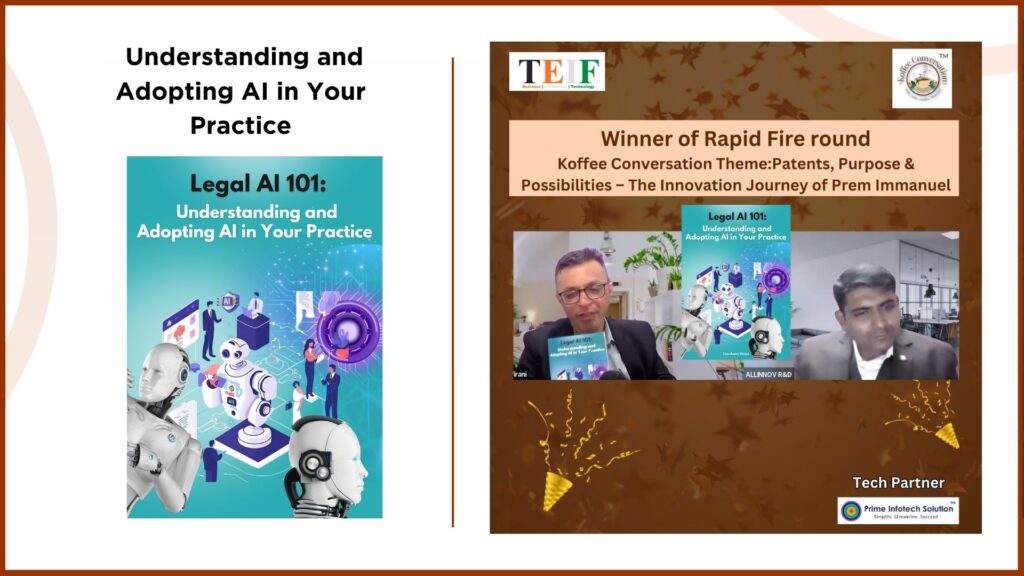
Key Highlights of the Koffee Conversation with Prem Charles Immanuel
- Innovation ecosystems succeed only when ideas are protected and commercialized effectively
- India has enormous innovation potential but still lacks widespread IP awareness
- Academic ecosystems in India often prioritize publications over protected research
- Many institutions focus on completing projects rather than commercializing innovations
- Students frequently disclose ideas publicly before filing patents, risking loss of protection
- Hackathons and ideathons can unintentionally expose innovations before IP filing
- Startups often prioritize fundraising before securing intellectual property rights
- Trademark searches and IP due diligence are still neglected by many early-stage startups
- Product-focused startups require fundamentally different IP strategies compared to service startups
- Academic innovations and industrial innovations operate with very different objectives
- Industries focus on scalable commercialization, while institutions often focus on completion metrics
- Strong innovation systems require purpose-driven and market-oriented research
- Commercialization is the missing bridge between research and market impact in India
- Utility model patents could empower India’s small innovators and manufacturers significantly
- China’s utility model ecosystem accelerated its manufacturing and export dominance
- Utility model protections can encourage grassroots innovation and reduce fear of copying
- India’s current IP enforcement systems still face challenges with counterfeiting and scalability
- Global IP understanding changes how innovations should be protected strategically across markets
- Some innovations may have stronger international markets than domestic opportunities
- Patent strategy should align with long-term market positioning and scalability
- AI is rapidly transforming patent drafting, novelty searches, and patentability analysis
- AI may disrupt many traditional legal and patent-related tasks in the coming years
- Human interpretation and strategic understanding will remain essential despite AI growth
- IP professionals must understand how AI interprets prompts and generates outputs
- Innovation strategy will increasingly combine AI with human judgment and commercialization insights
- Students should not fear entrepreneurship and startup creation after graduation
- Incubation centers require more real-world business exposure and mentorship ecosystems
- Innovation grows when ecosystems encourage experimentation without fear of failure
- Entrepreneurship requires long-term resilience, family support, and emotional stability
- “Innovator creating for innovators” became the defining philosophy of his journey
▶️ Watch the full episode on YouTube on The Koffee Conversation Show – Emerging Lawyer Series to explore how patents, innovation strategy, startups, AI, commercialization, academic ecosystems, and entrepreneurship are shaping India’s innovation-driven future.
🎧 Listen to the full episode on Spotify on The Koffee Conversation Show – Emerging Lawyer Series to explore how patents, innovation strategy, entrepreneurship, AI, commercialization, and intellectual property can transform ideas into scalable impact and drive India’s innovation economy forward.









0 Comments