

Dr. Pallab Das represents the modern legal academician who blends intellectual rigor with empathy, compassion, and human-centered leadership. As Founding Dean of the School of Law at Centurion University of Technology and Management, and a distinguished scholar in maritime arbitration and mental health law, he has built a journey that spans judicial services, international academia, research, mentorship, and institution-building. What sets him apart is his belief that legal education must create not just skilled lawyers—but emotionally aware, socially responsible, and future-ready human beings.
In this episode of The Koffee Conversation Show – Emerging Lawyer Series, Dr. Pallab shares a deeply reflective perspective on legal education, AI in academia, maritime arbitration, mental well-being, leadership, pedagogy, generational shifts, and the human side of law. His insights highlight a powerful truth—the future of legal education lies not only in teaching statutes and precedents, but also in nurturing emotionally resilient individuals capable of empathy, independent thinking, and responsible leadership. His journey reflects courage, purpose, and compassion.

Dr. Pallab’s legal journey began with a conscious choice to pursue law as a calling rather than an accident. From studying law in Pune to joining the Odisha Judicial Services, and later making the difficult decision to leave a secure judicial career for higher studies in the UK, his path has consistently been shaped by bold decisions rooted in learning and growth. His academic journey through Swansea University, followed by pioneering maritime law education at National Law University Odisha, reflects his commitment to building niche and future-oriented legal ecosystems in India.
A defining aspect of his journey has been institution-building through compassion and conviction. When he joined Centurion University, there was no law school infrastructure, no approvals, and no established system in place. Building the school from scratch required vision, persistence, and trust in people who believed in him. His story proves that meaningful leadership is not about authority—it is about creating environments where people and ideas can grow together.
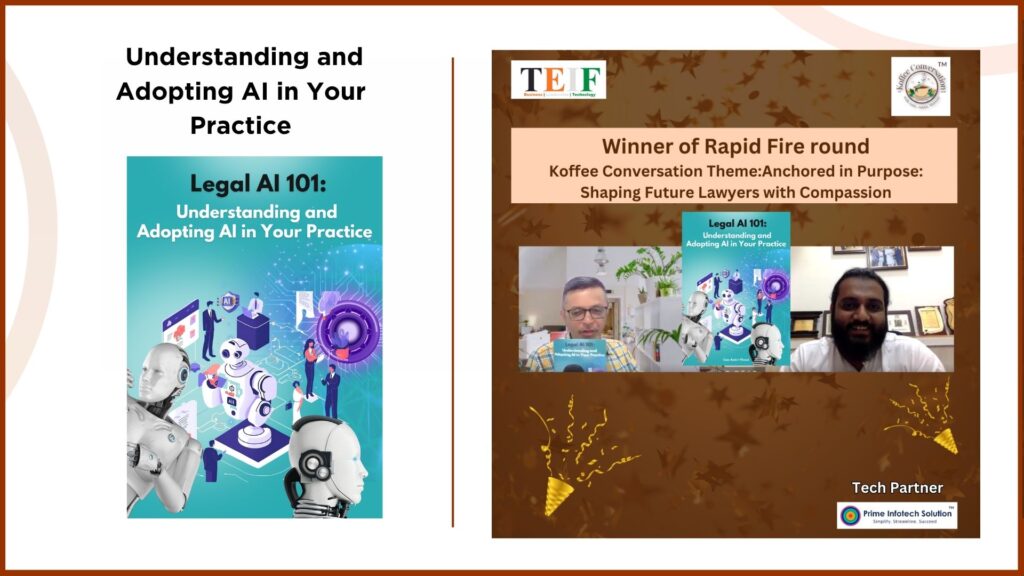
Key Highlights of the Koffee Conversation with Dr. Pallab Das
- Law should always be a conscious choice—not merely a career accident
- Legal education must evolve with changing generations and learning patterns
- AI is transforming research, teaching, and legal pedagogy fundamentally
- Artificial intelligence should be integrated thoughtfully into legal education—not feared or avoided
- Prompt engineering and critical thinking are becoming essential future-ready skills
- Traditional “spoon-feeding” education models no longer work effectively
- Professors should help students become independent thinkers and researchers
- Real-world legal learning requires practical problem-solving beyond theoretical memorization
- Students today have instant access to theory; teaching must now focus on application and interpretation
- International education builds survival skills, independence, and global awareness
- Exposure to diverse cultures changes professional outlook and intellectual maturity
- Professors abroad often teach from their own scholarship and original research contributions
- Maritime arbitration remains one of the most niche and commercially valuable legal sectors
- India still has significant untapped potential in maritime law research and practice
- Legal curriculum in India requires stronger interdisciplinary integration
- Every generation has strengths—educators must adapt instead of criticizing younger generations
- Human connection and emotional intelligence are becoming increasingly critical in the digital era
- Excessive dependence on mobile phones and virtual interactions is impacting emotional well-being
- Mental health awareness must become part of everyday conversations and education systems
- Lawyers and professionals require empathy and human touch as much as technical expertise
- Building institutions requires courage, persistence, and collective support systems
- Quality of education matters more than quantity of admissions
- Students ultimately become the true ambassadors of any educational institution
- Decision-making and standing by one’s decisions are essential life skills
- Financial literacy and basic life management should be taught to every student
- Independence and practical life skills are as important as academic knowledge
- Creativity cannot always be explained—it is often something deeply felt
- Nature, art, and animals create emotional grounding and peace
- Pain and struggle can shape resilience and emotional depth in leadership
- “Rare human” became the defining phrase describing his identity and outlook
▶️ Watch the full episode on YouTube on The Koffee Conversation Show – Emerging Lawyer Series to explore how legal education, compassion, AI, maritime arbitration, mentorship, creativity, and emotional resilience are shaping the next generation of lawyers and leaders.









0 Comments