

Dr. Balvinder Singh Banga represents the modern technology leader who bridges enterprise innovation, operational excellence, and human-centered leadership. As Group CTO at V-Trans (India) Ltd, he has spent over two decades transforming logistics and transportation ecosystems through AI, cloud modernization, enterprise architecture, digital platforms, and large-scale technology adoption. What distinguishes his leadership philosophy is a simple but powerful belief: technology should empower people, not overpower them.
In this episode of The Koffee Conversation Show – Emerging Professional Series, Dr. Banga shares a compelling perspective on AI, logistics transformation, enterprise leadership, digital governance, innovation, resilience, and the future of intelligent supply chains. His insights highlight a powerful truth—technology alone does not create transformation; transformation happens when technology, people, processes, and leadership work together toward a common purpose.

His journey began as a software developer in the late 1990s, where he quickly realized that technology solutions often failed because developers were disconnected from real operational needs. This realization led him toward logistics—a sector that at the time was largely overlooked by technology professionals. Seeing untapped potential, he entered the industry and gradually evolved from developer to enterprise technology leader, witnessing multiple generations of technological transformation along the way.
A defining aspect of his career has been his commitment to solving real-world operational challenges through technology. Whether improving transportation efficiency, reducing logistics costs, enabling digital visibility, implementing AI-driven systems, or modernizing legacy platforms, Dr. Banga consistently focuses on technology that delivers measurable business and societal value.
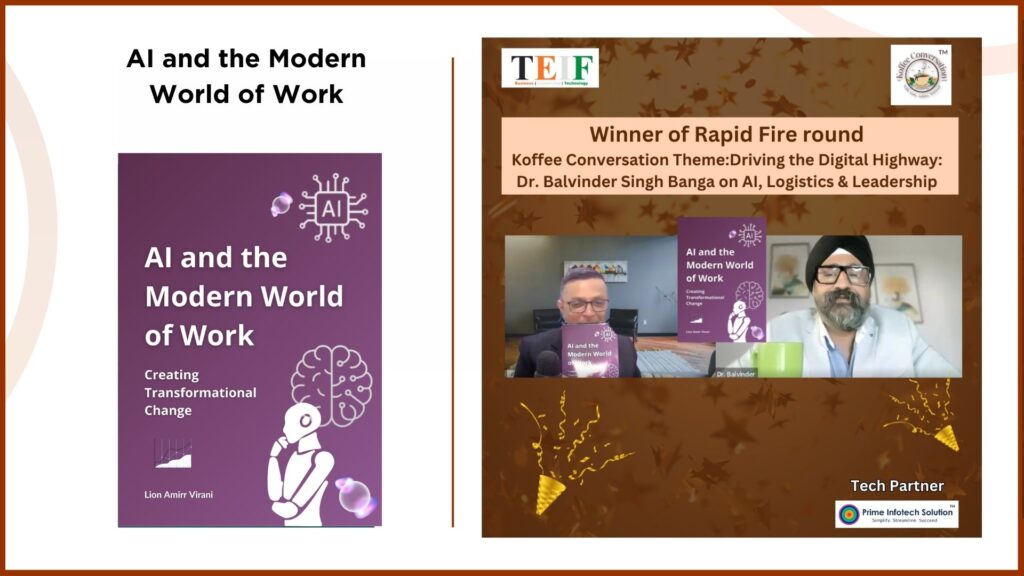
Key Highlights of the Koffee Conversation with Dr. Balvinder Singh Banga
- Technology and operations must work together to create meaningful business outcomes
- Logistics offers immense opportunities for technology-led transformation
- Technology evolves rapidly, but business needs remain remarkably consistent
- Governance becomes increasingly critical in the age of AI and automation
- AI systems require accountability, auditability, transparency, and ethical guardrails
- Organizations should understand the purpose behind technology before implementation
- Responsible AI requires strong governance frameworks
- Scalability without governance often creates long-term operational risks
- AI can significantly improve transportation safety and operational efficiency
- Advanced driver assistance systems (ADAS) have the potential to reduce road accidents
- Driver fatigue monitoring can help prevent accidents before they occur
- Transportation optimization can reduce fuel costs and improve operational planning
- AI-driven route intelligence enables more efficient logistics networks
- Data-driven decision-making can dramatically improve transportation economics
- Digitalization can reduce costs while increasing visibility across supply chains
- Real-time visibility has fundamentally transformed logistics operations
- Modern control towers provide instant access to fleet and shipment information
- GPS, dashboards, analytics, and big data have replaced manual tracking processes
- Logistics leaders can now monitor thousands of vehicles simultaneously through centralized platforms
- Digital transformation has significantly improved customer transparency and operational control
- Crisis situations often accelerate innovation and organizational agility
- The COVID-19 pandemic became a catalyst for large-scale digital adoption
- Electronic Lorry Receipt (ELR) implementation helped maintain logistics continuity during lockdowns
- Regulatory flexibility and technology innovation enabled critical supply chain operations during the pandemic
- Crisis-driven innovation often eliminates unnecessary bureaucracy
- Necessity remains one of the strongest drivers of innovation
- Technology transformation challenges are often more human than technical
- Legacy system migration requires managing behavioral change and resistance
- Employees frequently struggle more with unlearning old systems than learning new ones
- Large-scale digital transformation depends heavily on training, communication, and adoption management
- Successful implementation requires balancing technology rollout with human readiness
- Enterprise leadership has evolved from hierarchical authority to collaborative enablement
- Modern leaders cannot be experts in every technology domain
- Leadership increasingly focuses on creating environments where expertise can flourish
- Technology leaders must shift from command-and-control models to facilitation models
- Information flow and value creation have become more important than positional authority
- Many transformation projects fail because leadership commitment weakens during execution
- Budget pressures often derail long-term transformation initiatives
- Delayed implementations reduce employee confidence and adoption
- End users should be involved early in technology design and implementation
- Ground-level operational knowledge often provides the most valuable transformation insights
- Sustainable transformation requires continuous stakeholder engagement
- Leadership effectiveness depends on empathy and understanding rather than authority alone
- High-performing teams thrive when purpose and expectations are clear
- Meaningful autonomy creates stronger ownership and accountability
- Continuous feedback strengthens organizational performance
- Employee recovery and well-being are essential for long-term productivity
- Burnout prevention should be part of leadership strategy
- People perform best when they feel trusted and supported
- The future of logistics will be increasingly AI-driven, connected, and data-centric
- Communication skills are becoming as important as technical expertise
- Programming languages evolve, but problem-solving and communication remain valuable
- Young technology professionals should avoid limiting themselves to a single technical specialization
- Emotional intelligence is becoming a critical leadership capability
- Human-centered leadership remains essential despite rapid technological advancement
- Logistics modernization plays a critical role in national economic growth
- Technology leaders should focus on creating lasting impact rather than short-term achievements
▶️ Watch the full episode on YouTube on The Koffee Conversation Show – Emerging Professional Series to explore how AI, logistics innovation, digital governance, leadership, transformation strategy, and human-centered technology are reshaping the future of transportation and supply chains.
🎧 Listen to the complete podcast on Spotify: The Koffee Conversation Show – Emerging Professional Series to discover Dr. Balvinder Singh Banga’s insights on AI-powered logistics, enterprise transformation, digital governance, leadership, innovation, resilience, and what it truly takes to drive the digital highway of the future.










0 Comments