

Dr. Shivani Srivastava represents the modern intellectual property strategist who seamlessly combines science, law, technology, and business to help innovators transform ideas into valuable assets. As Founder of IntevoIP, she has spent more than two decades working with startups, universities, researchers, enterprises, and innovators, helping them protect, commercialize, and maximize the value of their intellectual property. What distinguishes her approach is her belief that IP is not merely a legal right—it is a strategic business tool that can drive growth, investment, and long-term competitive advantage.
In this episode of The Koffee Conversation Show – Emerging Lawyer Series, Dr. Shivani shares powerful insights on patents, trademarks, startup innovation, IP commercialization, AI in intellectual property, technology-driven innovation, academic research, entrepreneurship, and the future of innovation ecosystems. Her perspective highlights a critical truth—innovation becomes truly valuable only when it is protected, strategically managed, and aligned with business objectives.

Interestingly, her journey into intellectual property was never planned. While preparing for a PhD in biological sciences, she was introduced to patenting through her mentor, who encouraged her to apply for the Government of India’s Women Scientist Scholarship Scheme. What began as an opportunity soon evolved into a lifelong passion, leading her to build expertise across patents, trademarks, IP strategy, valuation, commercialization, and innovation management. Over the last twenty years, she has witnessed firsthand the transformation of India’s innovation ecosystem and the growing importance of IP in business success.
A defining aspect of her career has been her commitment to helping innovators understand that filing patents is only the beginning. Through her work with startups, universities, and businesses, she consistently emphasizes building strong IP portfolios that contribute to revenue generation, investor confidence, and sustainable growth. Her story demonstrates that successful innovation requires both creativity and strategic protection.
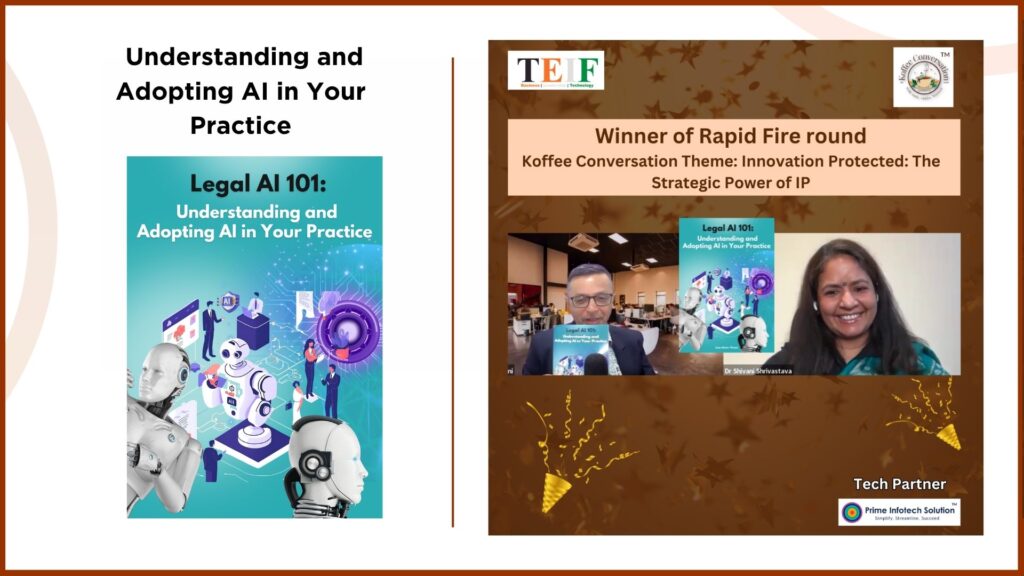
Key Highlights of the Koffee Conversation with Dr. Shivani Srivastava
- Intellectual property should be viewed as a business asset rather than merely a legal protection mechanism
- Many successful careers emerge from unexpected opportunities rather than predetermined plans
- Government-supported innovation and research programs continue to create valuable opportunities for professionals and researchers
- Innovation becomes valuable when it is strategically protected and commercialized
- Startups frequently delay IP protection until after discussing their ideas with investors and stakeholders
- Premature disclosure remains one of the biggest mistakes made by startups
- Patent protection should ideally be considered before public disclosure of innovations
- Trademark searches are critical before launching brands and products
- Many startups face avoidable legal disputes because trademark due diligence is ignored
- IP awareness significantly reduces future business risks
- Patents should not be filed merely for numbers or recognition
- Every patent filing should align with a clear business objective
- Strong IP portfolios contribute to valuation, investment attraction, and long-term growth
- Commercialization should remain central to IP strategy
- Companies increasingly invest in intellectual property as a strategic business asset
- Modern businesses often prioritize IP investments over physical infrastructure investments
- Remote work and virtual business models have increased the importance of intangible assets
- Intellectual property has become a key driver of enterprise value creation
- Innovation ecosystems are becoming increasingly knowledge-driven
- AI, biotechnology, deep technology, and emerging sectors present unique IP challenges
- Rapid technological evolution creates challenges for existing legal frameworks
- Ownership of AI-generated inventions remains an evolving global discussion
- Questions regarding inventorship, ownership, and accountability continue to shape AI-related IP debates
- Regulatory frameworks often struggle to keep pace with technological advancements
- IP due diligence plays a critical role during investments, acquisitions, and mergers
- Investors increasingly evaluate IP ownership and protection before committing capital
- Strong IP governance improves investor confidence
- Due diligence helps identify ownership risks and procedural gaps
- Patent ownership clarity becomes increasingly important during business expansion
- Awareness and education remain key drivers of stronger innovation ecosystems
- Many inventors still misunderstand how patent systems operate
- Trust in legal and regulatory institutions is essential for effective IP protection
- AI-generated patent specifications require careful human review
- AI can assist drafting but often lacks technical depth, specificity, and strategic nuance
- Generic AI outputs may fail to meet the standards required for strong patent protection
- Human expertise remains critical in patent drafting and strategy
- Patentability assessments should not be bypassed in favor of speed
- AI should complement professional expertise rather than replace it
- Technical knowledge significantly strengthens IP advisory capabilities
- Scientific backgrounds can provide a strong foundation for intellectual property careers
- Patent landscaping offers valuable insights into innovation trends and competitive environments
- Interdisciplinary expertise creates significant advantages in IP practice
- Entrepreneurship changes professional priorities and perspectives
- Running an independent practice requires resilience, adaptability, and relationship management
- Time management becomes increasingly important for entrepreneurs
- Client relationships are often the foundation of sustainable business growth
- Professional processes should continuously evolve based on client requirements and market changes
- Universities remain one of the largest sources of innovation and invention
- Academic institutions are increasingly prioritizing patent filings alongside research publications
- Government awareness programs have significantly improved IP understanding in academia
- Researchers are becoming more conscious of commercialization opportunities
- Innovation ecosystems benefit when academia and industry collaborate effectively
- AI adoption within IP practice should be approached thoughtfully and strategically
- Open AI tools may not always provide sufficiently accurate or specialized outputs for patent work
- Human review remains essential for quality assurance and legal accuracy
- Concerns about AI replacing professionals may be overstated
- Expertise, judgment, and contextual understanding remain valuable differentiators
- Future IP professionals should understand technology, business, and law simultaneously
- Curiosity remains one of the most important traits for long-term success
- Continuous learning is essential in rapidly evolving innovation ecosystems
- Understanding both technical and commercial aspects improves IP effectiveness
- Intellectual property careers reward interdisciplinary thinking
- Innovation requires both creativity and strategic execution
- Strong professional growth often emerges from embracing unexpected opportunities
- Integrity remains a foundational professional value
- Family support plays a significant role in sustaining entrepreneurial journeys
- Leadership often involves empowering others rather than controlling them
- Strategic thinking is becoming increasingly important in modern innovation management
- Adaptability remains critical in technology-driven industries
- Intellectual property will continue to play a central role in future business competitiveness
- The future belongs to innovators who understand how to create, protect, and commercialize knowledge assets effectively
▶️ Watch the full episode on YouTube on The Koffee Conversation Show – Emerging Lawyer Series to explore how patents, trademarks, IP strategy, innovation commercialization, AI, startup growth, and intellectual property protection are shaping the future of innovation and entrepreneurship.










0 Comments